
If you are purchasing a property with someone else, whether this be a spouse, partner, sibling, parent, other family member or friend, there are two different ways in which you can choose to legally hold the property – as joint tenants or tenants in common.
Both have different implications for each owner’s rights to jointly held property, and it is essential that you own the property in a way that best fits your requirements and circumstances, and that all co-owners share the same understanding of what this agreement is. If you are buying, selling, or transferring property, our Residential Property Lawyers can help you understand which ownership structure is most suitable for your situation.
Owning a property as Joint Tenants
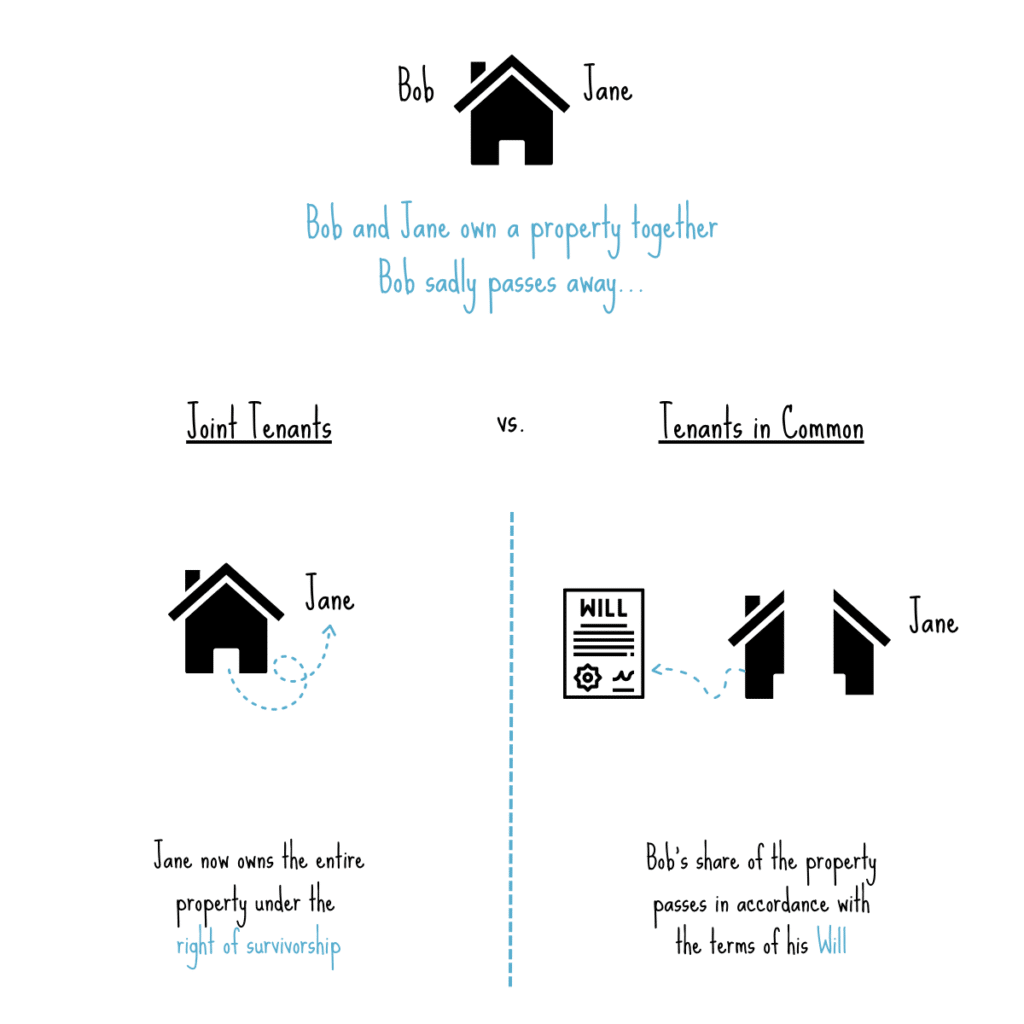
If you hold the property as joint tenants, you are each entitled to share equally in the net proceeds of sale (i.e., the sale price less repayment of mortgages, estate agents’ commission and legal costs). If you sell the property, it will be presumed that you both own the property equally, regardless of your respective contributions to the purchase price.
If one of you dies, then the Law of Survivorship will apply, and the deceased’s interest will automatically pass to the survivor regardless of any provisions that the deceased may have made in their Will or, if applicable, the Law of Intestacy. The surviving co-owner would then own all the property, and, upon their death, it would form part of their estate.
If you own as Joint Tenants, you should understand the implications. Either party can sever the Joint Tenancy Agreement at any point without the consent of the other party by serving what is called a Notice of Severance. Should this happen, the property is then automatically held as Tenants in Common, meaning that both parties are then free to leave their share in the property to whoever they wish.
The Joint Tenancy may also be served automatically in several situations, including where one party becomes bankrupt.
Owning a property as Tenants in Common
As Tenants in Common, each co-owner owns a specific share of the property. If the property is held as tenants in common, then it is possible for you to determine the interest that each of you will have in the net proceeds of sale, and it need not necessarily be equal shares: it could be, for example, 70:30, 80:20, 60:40, etc., depending upon the contributions each of you has made or whatever arrangement you may have reached. You can either specify the shares in the Transfer Deed or in a separate Declaration of Trust. If you do not specify any shares, then the law will assume that it is 50/50.
If one of you dies, then the interest of the deceased in the property will not automatically pass to the survivor but will devolve according to the terms of the deceased’s Will or, if applicable, the Law of Intestacy. Where the deceased’s interest does not pass to the survivor, but to a third party, this would usually mean that the property must be sold, and usually that Probate will need to be obtained for the deceased for the purposes of the devolution of the property.
Declarations of Trust to outline how a property should be divided
Whilst you can specify the different shares in the Transfer Deed, you should also consider executing a Declaration of Trust to deal with the property during your lifetime. A Declaration of Trust is a legally binding document that clearly outlines what you each own and how the property’s value would be divided should you ever split up or sell the property.
A Declaration of Trust can specify provisions as to future contributions to the property, and an agreed procedure should the property have to be sold in your lifetime. They are also a useful tool should there ever be a dispute about each co-owner’s share in the property and can be used as evidence of your intentions.
Without such evidence, it may be difficult for co-owners to prove what percentage of the property they own, and this could ultimately lead to lengthy and expensive Court Proceedings to obtain an order for the division of the property.
You will need to consider whether each person’s share will be fixed from the outset or whether the shares will vary according to the financial contributions made by each person during your ownership of the property.
In coming to your decision, you should think about the following:
- If you opt for fixed shares, your shares may be equal, but they do not have to be. Holding the property as tenants in common in unequal shares may be desirable if you have made unequal contributions to the purchase price of the property. If your shares are fixed, you will need to decide the size of those shares now. You may therefore need to revisit the split if there is a change of circumstances in the future, which you want to reflect in the proportions in which you own the property. An example would be if only one of the co-owners pays the costs of significant improvements to the property.
- If your financial contributions towards the property throughout your ownership may be unequal (for example, if one person pays a larger proportion of the mortgage repayments or the costs of any major works to the property), you may want your shares to reflect this. This means that your respective shares in the property may vary from time to time, depending on who pays what. The calculations will be more complex, and you will need to keep accurate records of each person’s contributions.
Even if you own the property as Joint Tenants, you may wish to consider having a Declaration of Trust because a Declaration of Trust for Joint Tenants can specify how a Joint Tenancy can be severed and on what basis the property would be owned after the severance.
If you do think a Declaration of Trust may be appropriate for you, then please note that it is important that this is in place at the point of completion of your purchase.
Cohabitation Agreements
If, as a couple, one of you owns a property, or you both own a property together, in the event of a separation, it may be that your partner claims an interest in your home or claims a bigger interest in the property than you considered they were entitled to.
In such cases, if one of you can establish an interest in the property, or a greater than equal interest in the case of a jointly owned property, then they could insist upon a sale of the property to recover their interest in the property, unless the other party was able to buy them out (and release them from any mortgage secured upon the property).
In cases like this, what the couple intended at the outset of their cohabitation, and how that intention evolved over time, is determinative. “Common intention” can be any express or implied shared intention of the couple to ‘share’ the property, however imprecise the terms. “Intention” can be inferred from conduct.
There can be no clearer statement of intent than a Cohabitation Agreement (with a property owned by one party) and a Cohabitation Agreement or Declaration of Trust (with a jointly owned property). A Cohabitation Agreement can be a more comprehensive and wide-ranging document than a Declaration of Trust and deal with a variety of matters and not limited to the property.
A cohabitation agreement, where properly entered into by the couple, will be determinative in the event of any dispute arising upon the couple’s separation and, because it is determinative, it should ensure that a dispute does not arise in the first place.
(NB – where there are dependent children, it may be possible for one party to “borrow” property, or equity from a property, to ensure that the children are adequately housed during their minority).
Why do people choose to hold a property as Joint Tenants or Tenants in Common?
Married couples or those in civil partnerships tend to hold property as Joint Tenants because the right of survivorship makes it straightforward to inherit each other’s shares in the property, but this does not mean that just because you are married, this is the right option for you.
There may be reasons not to become joint tenants. For example, if one of you has made a larger contribution to the purchase price of the property, you would want this to be recognised if the property is sold or if you separate. A joint tenancy may not be suitable if you have a family from an earlier marriage and wish to leave your interest in the property to them, instead of passing it to the other co-owner.
Unmarried couples, couples in a second marriage, business partners, house-share purchasers, and those making unequal contributions and/or repayments are often advised to hold the property as tenants in common.
For tenants in common, as the deceased’s share goes to their chosen beneficiaries via a Will or the Rules of Intestacy, it is often a preferable ownership for those who are not married/ in a relationship, e.g., friends or investors, and/or owners who have made unequal contributions towards the purchase of the property.
You may decide that this option is more appropriate (because of unequal contributions to the price or mortgage repayments, for example) and that you would want this division if you were to sell the property in your lifetime, but that you would still want the property to pass to the survivor on your death. This can be dealt with by holding the property as Tenants in Common and drawing up Wills which confirm that you wish your share in the property to pass to your co-owner.
What happens if a Joint Tenant has specified their share should go to someone else in their Will?
If a joint tenant specifies in their Will that their share of a property should go to a beneficiary other than the person(s) with whom they jointly own the property, that provision in their Will is usually considered invalid, as the “right of survivorship” overrides any instructions in a Will, and the gift will fail.
If you own as Tenants in Common, then on your death, the property will not pass automatically to your co-owner by survivorship, and therefore it is imperative that you have an up-to-date Will that reflects your wishes.
How many owners can a property have?
In England and Wales, up to four people can legally own a property together. While only four names can appear on the legal deeds, more people can hold a beneficial interest, although this is less common.
What if I don’t know how I hold a property?
Your conveyancer should have made it clear when you purchased the property whether you held it as joint tenants or tenants in common. If you can’t remember or can’t find the associated paperwork, you can obtain a copy of the title deeds from the Land Registry website, which will provide the details.
Note that, whilst good practice, a notice of severance does not need to be registered with the Land Registry to be effective, so a property’s deeds may not always show the correct position. If someone has served notice and not updated the title, as long as they can evidence that it’s been served, it will be deemed as effective.
Need Advice on Joint Tenants or Tenants in Common?
Choosing how to own a property is an important legal and financial decision, particularly if you are purchasing with a partner, family member, or friend. At THP Solicitors, our Residential Property team can advise you on the best option for your circumstances, help you put Declarations of Trust or Cohabitation Agreements in place, and ensure your interests are protected from the outset.
To speak with one of our Residential Property Lawyers, contact us today.